Read from the specification itself, not summarised from anywhere else.
Source: Cambridge IGCSE Literature in English 0475 syllabus, 2026: Version 2, published December 2025; 2027: Version 2, published October 2024 (read 2026-09-19).
See it unfold
The shape of the whole text, each key moment in turn, and how the people in it connect.
Tension arc
How tension rises and falls. Select a point to open that moment.
Tension is a reading of the text, not a fact about it: use it for the shape, and argue with it.
Key moments
“Let Rome in Tiber melt, and the wide arch Of the ranged empire fall!”
Moment 1 of 25 · Act 1, Scene 1
Rome’s verdict, Egypt’s reply
Setting: Cleopatra's palace in AlexandriaTension
Antony's follower Philo shows Demetrius their general with Cleopatra and calls his love dotage, a foolish infatuation. Antony refuses to hear the messengers from Rome and declares that the nobleness of life is love like theirs.
“Let Rome in Tiber melt, and the wide arch / Of the ranged empire fall!”
Who
PPhilo
DDemetrius
AAntony
CCleopatra
Why it matters
The play opens with a Roman judgement and an Egyptian answer, and leaves the audience to weigh them.
Roman Stoicism vs Egyptian SensualityLove vs Duty
Act 1, Scene 1: Rome’s verdict, Egypt’s reply. Antony's follower Philo shows Demetrius their general with Cleopatra and calls his love dotage, a foolish infatuation. Antony refuses to hear the messengers from Rome and declares that the nobleness of life is love like theirs. "Let Rome in Tiber melt, and the wide arch / Of the ranged empire fall!" The play opens with a Roman judgement and an Egyptian answer, and leaves the audience to weigh them.
Act 1, Scene 2: News from Rome. A soothsayer reads the fortunes of Cleopatra's women. Messengers bring Antony news of his wife Fulvia's wars against Caesar, of a Parthian advance, and then of Fulvia's death. With Pompey challenging Caesar at sea, Antony resolves to leave Egypt. "These strong Egyptian fetters I must break, / Or lose myself in dotage." Rome pulls Antony back, and the Soothsayer’s promise that Charmian will outlive her mistress comes true, by moments, in the last scene.
Act 1, Scene 3: A parting performed. Cleopatra pretends to be sick and scornful, mocks Antony for weeping too little for Fulvia, and tells him to act a scene of grief. At last she drops the game and wishes him victory, and he tells her that his heart remains with her. "Eternity was in our lips and eyes" Their parting is a quarrel, staged by a queen who treats every feeling as a role.
Act 1, Scene 4: Caesar's case against Antony. In Rome Caesar complains to Lepidus that Antony wastes his nights in revels, while Pompey grows strong at sea. He remembers Antony's endurance on the hard retreat from Modena, and wishes his shames would drive him back to Rome. "A man who is the abstract of all faults / That all men follow." The first Roman scene gives Caesar’s view of Antony, a great soldier ruined, which the play will test against Egypt’s.
Act 1, Scene 5: Serpent of old Nile. Cleopatra longs for the absent Antony, asks for a drug to sleep away the time, and imagines him on his horse thinking of her. Alexas brings a pearl Antony sent, and she vows to write to him every day. "Where’s my serpent of old Nile?" Alone with her women, Cleopatra’s love sounds real, and she dismisses her earlier love for Julius Caesar as belonging to her salad days.
Act 2, Scene 2: A marriage, and a barge. Antony and Caesar quarrel, then are reconciled when Agrippa proposes that Antony marry Caesar's sister Octavia. Left with Agrippa and Maecenas, Enobarbus describes Cleopatra's first meeting with Antony on the river Cydnus and insists Antony will never leave her. "Age cannot wither her, nor custom stale / Her infinite variety." The political marriage and the greatest description of Cleopatra share a scene, and the second makes the first look doomed.
Act 2, Scene 3: The Soothsayer's warning. Antony promises Octavia that his faults are behind him. Alone with him, the Soothsayer warns that Caesar's fortune will rise higher and that Antony's spirit is overpowered near him. Antony admits Caesar wins every game they play, and decides to return to Egypt. "And though I make this marriage for my peace, / I’ th’ East my pleasure lies." A scene after agreeing to the marriage, Antony is already planning his return to Egypt.
Act 2, Scene 5: The messenger. A messenger tells Cleopatra that Antony has married Octavia. She strikes him, drags him about and draws a knife, then has him called back to hear it again, and sends Alexas to find out what Octavia looks like, down to her height and the colour of her hair. "Melt Egypt into Nile, and kindly creatures / Turn all to serpents!" Cleopatra’s rage is violent and comic at once, and the man who brings bad news pays for it.
Act 2, Scene 7: Pompey's galley. Pompey feasts the triumvirs on his ship after their peace treaty. Menas offers to cut the cable and kill all three rulers, making Pompey lord of the world; Pompey refuses because it would stain his honour, and Menas decides to abandon him. Soon afterwards the drunken Lepidus is carried off. "’Tis not my profit that does lead mine honour; / Mine honour it." The world is offered and refused in a single aside, and the drunken feast shows how fragile the peace is.
Act 3, Scene 6: Enthroned in Alexandria. Caesar tells his followers that Antony and Cleopatra have been publicly enthroned in Alexandria, giving kingdoms to Cleopatra and to their sons. Octavia arrives in Rome without ceremony, hoping to make peace, and learns from her brother that Antony has gone back to Cleopatra. "Cleopatra / Hath nodded him to her." Antony’s return to Egypt gives Caesar his reason for war, and Octavia becomes its injured pretext.
Act 3, Scene 7: By sea, by sea. Cleopatra insists on taking part in the war. Antony decides to fight Caesar at sea because Caesar dares him to, although Enobarbus, Canidius and a battle-scarred soldier all urge him to trust his strength on land. "O noble emperor, do not fight by sea." Antony chooses the battle his enemy wants, and chooses it, it seems, out of pride.
Act 3, Scene 10: Actium. Enobarbus and Scarus watch the sea battle. In the middle of the fight Cleopatra's ships turn and flee, and Antony follows her, abandoning his fleet. Canidius resolves to surrender his legions to Caesar; Enobarbus, against his reason, stays with Antony. "The greater cantle of the world is lost / With very ignorance." The turning point: the soldier follows the lover out of the battle, and the world goes to Caesar.
Act 3, Scene 11: Shame, and a kiss. Antony, ashamed, tells his followers to take his treasure and make peace with Caesar. He reproaches Cleopatra for leading him away, and she begs his pardon, saying she never thought he would follow. He forgives her for a single kiss. "Fall not a tear, I say; one of them rates / All that is won and lost." Defeat does not end the love; it shows how much Antony will give up for it.
Act 3, Scene 13: Thidias whipped. Caesar's messenger Thidias invites Cleopatra to abandon Antony, and she seems to submit. Antony finds Thidias kissing her hand, has him whipped, and rages at her until she swears her loyalty. They plan one more night of feasting, and Enobarbus decides to leave him. "I will seek / Some way to leave him." Antony’s courage returns as his judgement fails, and his most clear-sighted friend begins to go.
Act 4, Scene 3: Hercules leaves him. On the night before the battle, soldiers on watch hear strange music under the earth. One of them says it is the god Hercules, whom Antony loved, deserting him, and they follow the sound to see where it leads. "’Tis the god Hercules, whom Antony loved, / Now leaves him." A short, eerie scene in which the supernatural confirms what the soldiers already fear.
Act 4, Scene 6: The treasure sent after him. Enobarbus has deserted to Caesar, and Antony has sent Enobarbus’s treasure after him, with gifts of his own and gentle greetings. A soldier brings the news to Enobarbus in Caesar’s camp. Overcome by his own disloyalty, he resolves to find a ditch to die in. "I am alone the villain of the earth" Antony’s generosity wounds the deserter more than any punishment could.
Act 4, Scene 8: A day of victory. Antony beats Caesar's forces back to their camp and returns to Alexandria victorious. He praises the wounded Scarus to Cleopatra, who gives Scarus a king's armour of gold, and orders a march through the city. "O thou day o’ th’ world" A last glimpse of Antony as the soldier he was, placed just before the final fall.
Act 4, Scene 9: Enobarbus dies. At night, near Caesar's camp, Enobarbus calls on the moon to witness his repentance, asks Antony to forgive him, and dies with Antony's name on his lips. The sentries who overheard him carry his body away. "Be witness to me, O thou blessed moon" The play’s realist dies of feeling, not reason, and asks to be remembered as a deserter.
Act 4, Scene 12: All is lost. Antony's fleet yields to Caesar and its sailors carouse with the enemy, and he is certain Cleopatra has betrayed him. When she comes to him he threatens her and drives her away, then swears that she will die for it. "All is lost! / This foul Egyptian hath betrayed me." The last defeat turns Antony’s love to hatred, and the play never confirms his suspicion.
Act 4, Scene 14: The shape of a cloud. Antony tells Eros he can no longer hold his own shape. Mardian brings Cleopatra's false message that she has died, and Antony asks Eros to kill him; Eros kills himself instead. Antony falls on his sword but does not die, learns from Diomedes that Cleopatra is alive, and asks his guard to carry him to her. "Here I am Antony, / Yet cannot hold this visible shape" A lie meant to calm him leads to his death, and even his Roman ending goes wrong.
Act 4, Scene 15: Death in the monument. Cleopatra, afraid of being captured, will not come down from her monument, so Antony is lifted up to her. He asks to be remembered as the greatest prince of the world, a Roman overcome by a Roman, and dies. She faints, then resolves to die as nobly as he did. "The crown o’ th’ earth doth melt." Antony dies an act early, leaving the last act of the tragedy to Cleopatra.
Act 5, Scene 1: Caesar mourns his rival. Dercetus brings Caesar Antony's bloodstained sword. Caesar is moved and praises him as his brother and partner in empire, then sends Proculeius to comfort Cleopatra, because he wants her alive for his triumph in Rome. "The breaking of so great a thing should make / A greater crack." Caesar’s grief may be genuine, but it never interrupts his planning.
Act 5, Scene 2: The dream of Antony. Romans seize Cleopatra in her monument before she can stab herself. She tells Dolabella her dream of a colossal Antony, and he admits Caesar means to lead her in triumph. Caesar visits, and her treasurer Seleucus reveals that she has held back part of her wealth. "I dreamt there was an Emperor Antony." Cleopatra makes a legend of Antony while learning exactly what Rome intends for her.
Act 5, Scene 2: Again for Cydnus. A countryman brings a basket of figs with asps hidden in it. Cleopatra puts on her robe and crown as for her first meeting with Antony. Iras dies first; Cleopatra sets an asp to her breast and dies; Charmian straightens her crown and dies as the guards arrive. "Give me my robe. Put on my crown. I have / Immortal longings in me." Cleopatra stages her own death as a queen and a bride, and denies Caesar his triumph.
Act 5, Scene 2: A pair so famous. Caesar arrives to find the three women dead. He admires Cleopatra's courage, works out how she died, and orders that she be buried beside Antony, with his army attending the funeral before he returns to Rome. "No grave upon the earth shall clip in it / A pair so famous." The winner of the war has the last word, and uses it to honour the lovers who beat him.
Character map
Select a person to see their relationships. Rings mark who is in the moment above.
Antony · lovers · Cleopatra
Rome calls it dotage; they call it the nobleness of life. Twice Antony accuses her of turning to Caesar, when Thidias kisses her hand and when his fleet yields, and her false report of her death leads to his. In the last scene she calls him husband.
Antony · fellow triumvirs, then enemies · Octavius Caesar
Partners in ruling the world who cannot share it. They are reconciled by a marriage and divided by Antony’s return to Egypt. After his death Caesar mourns him as “my brother, my competitor”.
Antony · husband and wife · Octavia
A political marriage to seal peace with Caesar. Octavia tries to reconcile husband and brother, returns to Rome, and learns that Antony has gone back to Cleopatra.
Octavius Caesar · brother and sister · Octavia
Caesar says no brother ever loved a sister so dearly, yet he gives her in marriage as “the cement of our love”, and her ill treatment becomes part of his case for war.
Antony · general and friend · Enobarbus
Enobarbus speaks the plain truth to Antony and warns him against fighting at sea. He deserts before the last battles; Antony sends Enobarbus’s treasure after him, and Enobarbus dies ashamed, calling Antony’s name.
Antony · master and freed servant · Eros
Antony freed Eros, who swore to kill him when the time came. Asked to do it, Eros kills himself instead, and Antony calls him “Thrice nobler than myself”.
Antony · husband and wife · Fulvia
Fulvia never appears. Her wars against Caesar draw Antony back to Rome, and the news of her death in Act 1, Scene 2 leaves him free to marry Octavia.
Cleopatra · queen and attendant · Charmian
Her closest companion. Charmian advises her, suggests the monument and the false report of her death, and after Cleopatra dies straightens her crown before dying herself.
Cleopatra · queen and attendant · Iras
Iras fears being shown in Rome as much as her mistress does. She dies first, after Cleopatra kisses her farewell.
Octavius Caesar · conqueror and captive queen · Cleopatra
Caesar promises her kindness but wants her alive to be paraded in his triumph. She sees through him with Dolabella’s help and outwits him, and he ends by admiring her as “Bravest at the last”.
Octavius Caesar · fellow triumvirs · Lepidus
Lepidus tries to keep the peace between his partners. Caesar uses him in the war against Pompey, then accuses and deposes him, as Eros reports in Act 3, Scene 5.
Pompey · commander and follower · Menas
Menas offers Pompey the world by murdering his guests. Pompey refuses for honour’s sake, and Menas resolves never to follow his fortunes again.
Cleopatra · captive and guard · Dolabella
Moved by her grief, Dolabella confirms that Caesar will lead her in triumph and later warns her he will send her ahead within three days.
Enobarbus · critic and admirer · Cleopatra
He mocks her habit of dying away on the slightest cause and opposes her presence at Actium, yet it is Enobarbus who gives the play its most dazzling description of her.
Characters as described
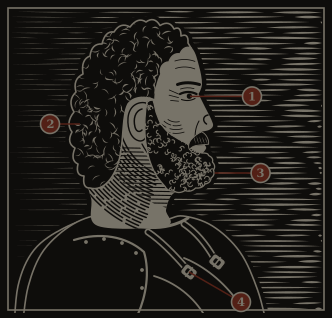
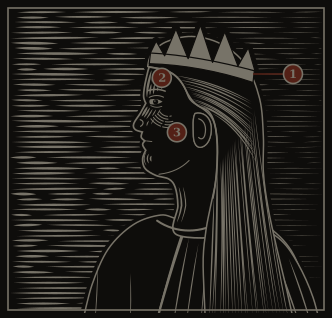
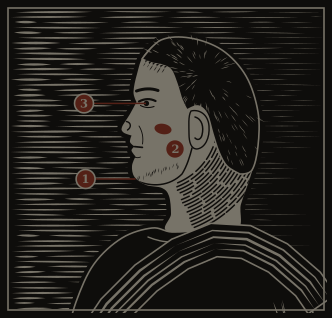
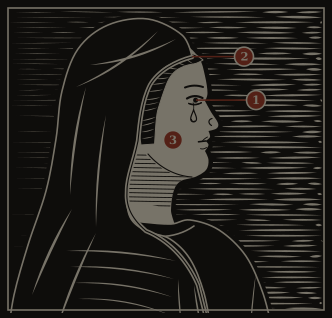
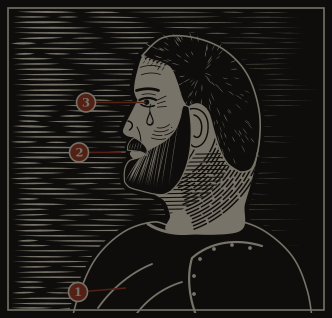
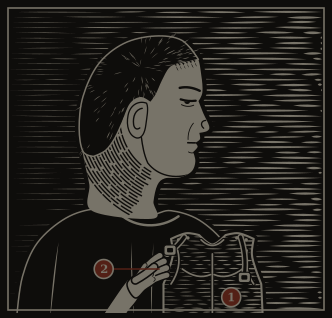
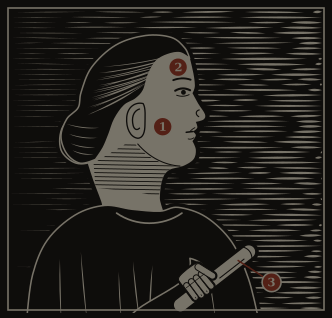
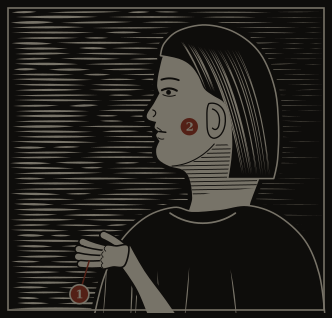
Each portrait is drawn from the words of the text, not from a film or a stage production. The numbers on the picture point to those words.
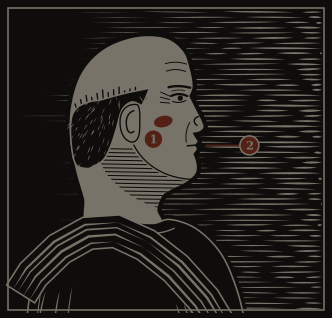
Antony
The words the numbers point to
1Those his goodly eyes
2Though grey Do something mingle with our younger brown
3Were I the wearer of Antonius’ beard
4burst The buckles on his breast
Act 1, Scene 1; Act 2, Scene 2; Act 4, Scene 8
The play opens with a Roman’s verdict: the eyes that once glowed over the army now look only at Cleopatra, and the heart that burst the buckles of his armour has given up all restraint. Antony knows he is going grey, and boasts after his last victory that he can still fight like a young man. A strong answer weighs the soldier he was against the lover he is.
Enobarbus gives him a beard and Antony gives himself the grey. The print cannot show brown, so his hair and beard are ink, with the grey cut into them as lighter curls. His curls and his armour are the panels’, and the play does not describe the armour.
Cleopatra
The words the numbers point to
1As I am Egypt’s queen
2Upon a tawny front
3with Phœbus’ amorous pinches black
Act 1, Scenes 1 and 5
Almost everything the play says of her looks is somebody’s judgement. Philo, a Roman, sneers at the “tawny front” his general gazes on; among her women, Cleopatra calls herself darkened by the sun and “wrinkled deep in time”; and Enobarbus, in Rome, says that “Age cannot wither her” and that her person “beggared all description”.
The print has no brown, so her face is cut as the print cuts anything dark, left in ink with the sunlight cut out of it. The play describes nothing else of her face, her hair or her dress: her hair, gown and mantle are how the panels draw her, and her crown is the one she calls for in the last scene.
Study guide sections
The rest of the guide, section by section: analysis, vocabulary and exam practice for this text.
Key passages for close reading
Octavius Caesar
The words the numbers point to
1the scarce-bearded Caesar
2he wears the rose Of youth upon him
3I have eyes upon him
Act 1, Scene 1; Act 3, Scenes 6 and 13
Cleopatra mocks his thin beard and Antony his youth, but Caesar is the one who watches: he says he has eyes on Antony, and the news comes to him on the wind. The boy they laugh at ends the play ruling the world.
The play gives his youth and his thin beard, and nothing else of his looks. The flush on his cheek is Antony’s “rose Of youth”, in the print’s one colour; his cropped hair and his toga are how the panels draw him.
Octavia
The words the numbers point to
1The April’s in her eyes.
2Brown, madam
3Octavia is of a holy, cold, and still conversation.
Act 2, Scene 6; Act 3, Scenes 2 and 3
Octavia is seen through men who use her or judge her. Enobarbus says her “conversation”, meaning her whole manner of life, is holy, cold and still, and predicts that Antony will go back to Egypt; Antony watches her weep at leaving her brother; and the colour of her hair is a frightened messenger’s answer to Cleopatra, who beat him for bringing the news of the marriage.
The print cannot show brown, so her hair is ink. The play does not describe her dress: the palla over her head is how a Roman wife went out, as Calpurnia does in the Julius Caesar portraits.
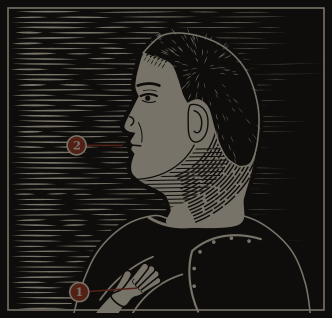
Enobarbus
The words the numbers point to
1Thou art a soldier only.
2Enjoy thy plainness
3I, an ass, am onion-eyed.
Act 2, Scenes 2 and 6; Act 4, Scene 2
Antony silences him as “a soldier only”, and Pompey likes him for his plain speaking. Yet the man who mocks everyone’s tears weeps at Antony’s farewell supper, and soon after deserts him: his honesty and his loyalty pull him apart.
The play does not describe his looks. He is drawn as the panels draw him, with a short dark beard and cropped hair, in a soldier’s armour without a general’s cloak.
Eros
The words the numbers point to
1Eros! Mine armour, Eros!
2Thou fumblest, Eros
Act 4, Scene 4
Eros is the servant Antony freed, the one he calls for when he arms for battle, and he stays loyal to the end. Antony teases him for fumbling with the buckles while Cleopatra does the job better: a rare moment of happiness on the morning of a battle.
The play does not describe him. He is drawn as the panels draw him, young and beardless with cropped hair, in a plain tunic; the breastplate is the plain armour the panels give every soldier.
Charmian
The words the numbers point to
1You shall be yet far fairer than you are.
2Wrinkles forbid!
3Ink and paper, Charmian.
Act 1, Scenes 2 and 5
Charmian is quick, funny and fiercely loyal. She laughs with the soothsayer about her fortune, advises her mistress how to keep Antony, and is sent for ink and paper so that Cleopatra can write to him every day he is away.
The play does not describe her looks: the soothsayer’s promise and her own joke are as near as it comes. Her bound hair and plain gown are how the panels tell her from Iras and from the queen.
Iras
The words the numbers point to
1Your fortunes are alike.
2The gods forbid!
Act 1, Scene 2; Act 5, Scene 2
Iras says little, but when the soothsayer reads her palm and Charmian’s he tells them their fortunes are alike, and so they prove: the two women stay with their queen to the end. When Cleopatra pictures them both paraded through Rome, Iras answers with horror.
The play does not describe her looks. Her hair cut level at the jaw and her plain gown are how the panels tell her from Charmian and from the queen.
Lepidus
The words the numbers point to
1Lepidus is high-coloured.
2Touch you the sourest points with sweetest terms
Act 2, Scenes 2 and 7
Lepidus tries to keep the peace between Antony and Caesar, begging them to put their quarrels gently. On Pompey’s galley the servants laugh that each time the others quarrel he makes peace and drinks again, until he is carried ashore; soon afterwards Caesar uses him and throws him out of power.
The play gives only his colour on the galley, which the print’s one colour shows on his cheek. He is drawn as the Julius Caesar panels draw him, slight and balding, so that he is the same man.
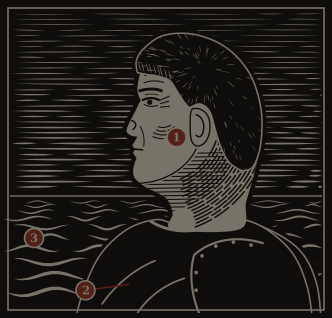
Pompey
The words the numbers point to
1What counts harsh Fortune casts upon my face
2But in my bosom shall she never come
3the sea is mine
Act 2, Scenes 1 and 6
Pompey is the son of the great Pompey whom Julius Caesar defeated, and he rules the sea. Caesar sees hard fortune written on his face, and Pompey answers that it shall never reach his heart. On his galley he refuses a crime that would make him master of the world, for honour’s sake, and so loses his chance.
The play does not describe his looks beyond the marks of fortune Caesar sees. His fringe and his armour are how the panels draw him; the sea behind him is the sea he claims.
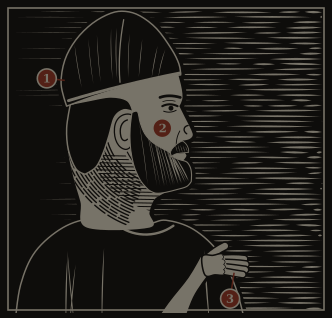
Menas
The words the numbers point to
1I have ever held my cap off to thy fortunes.
2All men’s faces are true
3give me your hand, Menas
Act 2, Scenes 6 and 7
Menas shakes hands with Enobarbus, two old enemies joking that they are both thieves, and claims that faces are honest whatever hands do. On the galley he offers Pompey the whole world by a crime; when Pompey refuses, Menas resolves to leave him.
The play does not describe his looks. His beard, his felt cap and his plain tunic are how the panels draw him, and tell him from Enobarbus.
Dolabella
The words the numbers point to
1a grief that smites My very heart at root
2Madam, he will. I know it.
Act 5, Scene 2
Caesar’s officer is moved by the captive queen’s grief, and when she asks whether Caesar means to parade her through Rome in triumph, he tells her the truth. Later he warns her that she is to be sent ahead within three days: a Roman whose kindness helps Cleopatra outwit his master.
The play does not describe his looks. He is drawn as the panels draw him, clean-shaven with cropped hair, in a soldier’s armour without a cloak.
Where to find it: Late in the scene, after Antony has agreed to marry Octavia and the leaders have gone out, leaving Enobarbus with Agrippa and Maecenas: from Enobarbus’s “I will tell you.” to “And made a gap in nature.”
ENOBARBUS:
I will tell you.1The barge she sat in, like a burnished throne,
Burned on the water.2 The poop was beaten gold;
Purple the sails, and so perfumed that
The winds were love-sick with them3; the oars were silver,
Which to the tune of flutes kept stroke, and made
The water which they beat to follow faster,
As amorous of their strokes. For her own person,
It beggared all description4: she did lie
In her pavilion, cloth-of-gold of tissue,
O’erpicturing that Venus where we see
The fancy outwork nature.5 On each side her
Stood pretty dimpled boys, like smiling Cupids,
With divers-coloured fans, whose wind did seem
To glow the delicate cheeks which they did cool,
And what they undid did.6
AGRIPPA:
O, rare for Antony!
ENOBARBUS:
Her gentlewomen, like the Nereides,
So many mermaids, tended her i’ th’ eyes,
And made their bends adornings. At the helm
A seeming mermaid steers. The silken tackle
Swell with the touches of those flower-soft hands
That yarely frame the office. From the barge
A strange invisible perfume hits the sense
Of the adjacent wharfs. The city cast
Her people out upon her, and Antony,
Enthroned i’ th’ market-place, did sit alone,7
Whistling to th’ air, which, but for vacancy,
Had gone to gaze on Cleopatra too,
And made a gap in nature.8
1“I will tell you.” Until this line Enobarbus has been swapping gossip with the Romans in prose. With these four words he moves into verse, and the shift tells the audience that what follows is a performance, a set piece he has perhaps told before, and not a plain report.
2“The barge she sat in, like a burnished throne, / Burned on the water.” The simile turns a boat into a seat of royal power, and the near-pun of “burnished” and “Burned” sets fire on water. Two elements that should cancel each other out burn together, which is the paradox the whole speech builds, and it looks forward to Cleopatra’s dying claim, “I am fire and air”.
3“The winds were love-sick with them” Personification makes nature itself fall in love: the winds are love-sick with the perfume, the water follows the oars “As amorous of their strokes”. Enobarbus does not describe Cleopatra at all yet. He describes the world responding to her, so that her power is felt before she is seen.
4“It beggared all description” He claims she is beyond words while spending nearly thirty lines on the scene. The word picks up the language of the opening scene, where Antony says “There’s beggary in the love that can be reckoned”. The play keeps suggesting that what is truly great cannot be counted or described, and that those who try come away poorer.
5“O’erpicturing that Venus where we see / The fancy outwork nature.” A painting of Venus shows imagination outdoing nature, and Cleopatra outdoes even that painting. Keep this in mind for Act 5, Scene 2, where Cleopatra makes the same move about Antony: nature, she says, lacks the material to compete with fancy, yet an Antony would be nature’s masterpiece against it. In both speeches the lover is the real thing that beats imagination.
The question: Explore the ways in which Shakespeare makes Enobarbus's description of Cleopatra so vivid and so persuasive in this passage. For an A-level essay, go on to consider how far the play presents Cleopatra through other people's words rather than letting the audience judge her for itself.
6“To glow the delicate cheeks which they did cool, / And what they undid did.” The fans that should cool her make her cheeks glow, so each action produces its opposite. The compressed final line, five short words, is almost a riddle. It prepares for Enobarbus’s famous paradox later in the scene that she “makes hungry / Where most she satisfies”.
7“Enthroned i’ th’ market-place, did sit alone,” The comic climax: the whole city runs to the river, and the great triumvir is left alone on his throne, whistling. Antony is upstaged and, in effect, conquered before they meet. In Act 3, Scene 6 Caesar will report the two of them enthroned together in the market-place, the private spectacle become a political scandal.
8“And made a gap in nature.” Hyperbole to finish: the air itself would have gone to gaze at her, except that its leaving would have left an empty space in nature. The speaker matters. This is Enobarbus, the play’s blunt soldier, and if even he talks like this, the audience is invited to believe Cleopatra really is extraordinary.
6
, my knave.
I made these wars for Egypt, and the Queen,
Whose heart I thought I had, for she had mine,
Which, whilst it was mine, had annexed unto’t
A million more, now lost—she, Eros, has
Packed cards with Caesar, and false-played my glory7
Unto an enemy’s triumph.
Nay, weep not, gentle Eros.
There is left us
Ourselves to end ourselves.8
1“Eros, thou yet behold’st me?” The scene opens with a question, and a strange one: Antony asks whether he can still be seen. A man who has lived as a public spectacle now doubts that he exists at all, and the rest of the speech explains the fear.
2“Sometime we see a cloud that’s dragonish,” The list of cloud shapes moves from beasts of strength (dragon, bear, lion) to things of permanence (a citadel, a rock, a mountain). Each can be read as an image of the soldier Antony used to be, and every one is made of vapour. The long, calm catalogue makes the dissolving feel slow and inevitable.
3“And mock our eyes with air.” The clouds deceive the eye, and Antony believes he has been deceived too. The line gathers the play’s worries about seeing and believing: the audience knows, from the scene before, that Cleopatra has only hidden in her monument.
4“They are black vesper’s pageants.” Vesper is evening, and a pageant is a show. The shapes are the night’s theatre, gone as darkness comes, and the image looks ahead to his own ending later in the scene: “The long day’s task is done, / And we must sleep.”
5“The rack dislimns and makes it indistinct / As water is in water.” The rack, the driving clouds, blurs the horse’s outline until it disappears as completely as water poured into water. In Act 1, Scene 1 Antony wished Rome to melt into the Tiber; now it is he who melts. The simile is the play’s image of dissolution at its most exact and most frightening.
6 The name remains but the self has gone. Throughout the play Antony measures himself by his name, “I am / Antony yet” in Act 3, Scene 13, and here the name and the man come apart. Spoken to a servant rather than to the audience, it is one of the most private moments Antony is given.
The question: How does Shakespeare make this such a moving and revealing moment for Antony? For an A-level essay, use the passage as the starting point for a discussion of how the play presents Antony's sense of who he is.
5
His delights
Were dolphin-like; they showed his back above
The element they lived in.6
In his livery
Walked crowns and crownets;
realms and islands were
As plates dropped from his pocket.7
DOLABELLA:
Cleopatra—
CLEOPATRA:
Think you there was or might be such a man
As this I dreamt of?
DOLABELLA:
Gentle madam, no.8
CLEOPATRA:
You lie up to the hearing of the gods!
But if there be nor ever were one such,
It’s past the size of dreaming.
Nature wants stuff
To vie strange forms with fancy9
; yet t’ imagine
An Antony were nature’s piece ’gainst fancy,
Condemning shadows quite.
1“You laugh when boys or women tell their dreams;” Cleopatra expects a Roman to sneer and says so first, which disarms the sneer. She is a prisoner, but she still controls how her words will be received. On Shakespeare’s stage Cleopatra was played by a male actor, most likely a boy, so the line can also be heard as a dare to the audience to laugh at the performance in front of it.
2“I dreamt there was an Emperor Antony.” The past tense makes Antony a figure of story already. The title is pointed: later in the scene Dolabella announces Caesar with “It is the Emperor, madam.” Cleopatra gives the title to the loser, and the play lets the two claims to it stand side by side.
3“His face was as the heavens, and therein stuck / A sun and moon” The description begins at the face, as a love poem would, and expands at once to the size of the universe. The earth itself shrinks to “The little O”, a speck lit by the sun and moon of his face, so that the whole world Caesar has just won becomes tiny beside him.
4“His legs bestrid the ocean” He becomes a colossus standing astride the sea. The image answers the history the audience has watched: the real Antony lost everything at sea, at Actium and again in Act 4, Scene 12, yet in Cleopatra’s telling the ocean is something he straddles with ease.
5“There was no winter in’t; an autumn ’twas / That grew the more by reaping.” A harvest that grows as it is gathered is a paradox of endless generosity. It is not only fantasy: in Act 4, Scene 5 Antony sent Enobarbus’s treasure after him when he deserted, and in the next scene Enobarbus called him “Thou mine of bounty”.
The question: Explore the ways in which Shakespeare makes Cleopatra's description of Antony such a powerful moment in the play. For an A-level essay, weigh the view that Antony is great only in Cleopatra's words, using this passage and the play as a whole.
Imagery of melting and dissolving
Example: “Let Rome in Tiber melt” (Antony, Act 1, Scene 1); “Melt Egypt into Nile” (Cleopatra, Act 2, Scene 5); “Authority melts from me” (Antony, Act 3, Scene 13); followers who “melt their sweets / On blossoming Caesar” (Antony, Act 4, Scene 12); “The crown o’ th’ earth doth melt” (Cleopatra, Act 4, Scene 15).
Effect: Trace the verb through the play and it changes direction. At first the lovers, in love or in fury, call on whole countries to melt; then Antony feels his own power and followers melting away from him; finally Cleopatra sees Antony himself dissolve. The chain makes his fall feel like a slow loss of solid shape, which Act 4, Scene 14 turns into an image of clouds.
Mandragora
Mandrake, a plant used as a sleeping drug. Cleopatra asks for it so that she can sleep through “this great gap of time / My Antony is away” (Act 1, Scene 5).
Soothsayer
A fortune-teller. The play’s Soothsayer says of himself, “I make not, but foresee” (Act 1, Scene 2). He tells Charmian she will outlive her mistress, and warns Antony that beside Caesar his guardian spirit is overpowered (Act 2, Scene 3).
Dæmon
A guardian spirit. The Soothsayer glosses the word himself, “that thy spirit which keeps thee” (Act 2, Scene 3), and warns that near Caesar it becomes afraid.
Garboils
Disturbances or uproar. Antony uses it of the trouble his wife Fulvia caused in Italy, “The garboils she awaked” (Act 1, Scene 3).
Yare
Quick, nimble; of a ship, easy to handle. Enobarbus warns that Caesar’s “ships are yare, yours heavy” before Actium (Act 3, Scene 7); Cleopatra hurries her women with “Yare, yare, good Iras” as she dresses for death (Act 5, Scene 2).
Cantle
A piece or segment cut from something. Scarus, watching Actium, says “The greater cantle of the world is lost” (Act 3, Scene 10).
Rack and dislimn
The rack is thin, broken cloud driven by the wind; to dislimn is to blur an outline until it disappears. Antony uses both of a cloud shaped like a horse: “The rack dislimns and makes it indistinct” (Act 4, Scene 14).
Vesper
Evening, or the evening star. Cloud shapes at dusk are “black vesper’s pageants”, the evening’s shows (Act 4, Scene 14).
Actium
The sea battle of 2 September 31 BC between Octavius and Antony. In the play Antony chooses to fight there “By sea, by sea” against his soldiers’ advice (Act 3, Scene 7), and Cleopatra’s ships flee in the middle of the fight (Act 3, Scene 10).
Triumph
A Roman victory procession in which captured leaders were paraded, often in chains. It is what Cleopatra most fears: Caesar wants her alive because “her life in Rome / Would be eternal in our triumph” (Act 5, Scene 1).
Lictors
Officers who attended Roman magistrates and carried out punishments. Cleopatra imagines “Saucy lictors” seizing her in Rome (Act 5, Scene 2).
Varletry
The rabble or mob. Cleopatra refuses to be shown to “the shouting varletry / Of censuring Rome” (Act 5, Scene 2).
Monument
Here, a tomb. Cleopatra locks herself in hers on Charmian’s advice (Act 4, Scene 13); Antony is lifted up into it to die (Act 4, Scene 15); and she dies there (Act 5, Scene 2).
Asp, aspic and worm
An asp is a small venomous snake; the name is used for the Egyptian cobra. The play also calls it an aspic, “Have I the aspic in my lips?”, and the Clown calls it “the worm”, an old word for a snake (Act 5, Scene 2).
Isis
A great goddess of Egypt, wife of Osiris and mother of Horus. Caesar reports that Cleopatra appeared “In th’ habiliments of the goddess Isis” (Act 3, Scene 6), and Plutarch records that the historical Cleopatra appeared in public in a robe sacred to Isis and was addressed as “the new Isis”. Charmian and Cleopatra swear by her.
Hercules, or Alcides
The hero from whom, by an old tradition recorded by Plutarch, Antony’s family claimed descent. Cleopatra calls Antony “this Herculean Roman” (Act 1, Scene 3); the soldiers take the music under the earth to mean “the god Hercules, whom Antony loved, / Now leaves him” (Act 4, Scene 3); and Antony calls on “Alcides, thou mine ancestor” (Act 4, Scene 12).
The shirt of Nessus
The poisoned shirt that killed Hercules. Antony, believing Cleopatra has betrayed him, cries “The shirt of Nessus is upon me” (Act 4, Scene 12): his rage and pain feel like Hercules’ agony.
Thetis and the Nereides
Sea nymphs, the daughters of the sea god Nereus; Thetis was one of them. Cleopatra’s women are “like the Nereides” on the barge (Act 2, Scene 2), and Antony calls Cleopatra “my Thetis” as they go to fight at sea (Act 3, Scene 7).
Blank verse
Unrhymed lines of ten syllables and five stresses, the main form of the play. The play opens in it: Philo’s first line, “Nay, but this dotage of our general’s”, has ten syllables. Characters drop into prose for jokes and gossip, as Enobarbus often does.
Hyperbole
Deliberate exaggeration. It is the lovers’ natural language, from Antony’s “new heaven, new earth” (Act 1, Scene 1) to Cleopatra’s dream of a colossal Antony (Act 5, Scene 2).
Aside and soliloquy
An aside is heard by the audience but not the other characters, as when Enobarbus says “Mine honesty and I begin to square” (Act 3, Scene 13); a soliloquy is spoken alone, as when he ends the same scene resolving to “seek / Some way to leave him”.
Metatheatre
Moments when a play draws attention to itself as a play. The clearest is Cleopatra’s fear that she will see “Some squeaking Cleopatra boy my greatness” (Act 5, Scene 2), spoken on Shakespeare’s stage by a male actor, most likely a boy.
“Here I am Antony, / Yet cannot hold this visible shape”
7“Packed cards with Caesar, and false-played my glory” The metaphor is of a cheat at cards stacking the pack. It recalls the Soothsayer’s warning in Act 2, Scene 3 that at any game with Caesar, Antony is sure to lose. The charge against Cleopatra is never proved: Diomedes later says it “never shall be found”, and the play leaves the fleet’s surrender unexplained.
8“There is left us / Ourselves to end ourselves.” The quiet line turns from grief to resolve. Antony treats death as the one choice defeat has left him, in the Roman way the play keeps returning to, and he comforts Eros rather than himself. The scene that follows treats that choice with dignity and with painful irony.
6
“His delights / Were dolphin-like; they showed his back above / The element they lived in.” A dolphin lives in the sea but leaps above it. The simile can be read as a reply to the Roman view of Antony, from Philo onwards, as a man drowned in pleasure: in Cleopatra’s version his pleasures never closed over his head.
7“realms and islands were / As plates dropped from his pocket.” Kingdoms fall from him as carelessly as small things dropped from a pocket. Hyperbole again, but it has a basis in the play: Caesar reported with disgust in Act 3, Scene 6 that Antony had given away kingdoms to Cleopatra and to their sons.
8“Gentle madam, no.” Three plain words from Dolabella set Roman fact against Egyptian imagination. They are kind as well as honest, and Cleopatra’s furious reply shows how much she needs the dream to be true.
9“Nature wants stuff / To vie strange forms with fancy” Her argument is compressed but precise: nature lacks the material to compete with imagination, and yet an Antony, if he existed, would be nature’s masterpiece against imagination. So, she implies, her Antony was no mere dream. The speech echoes the barge speech of Act 2, Scene 2, where Cleopatra outdid a painting in which fancy outdid nature: in both, the lover is praised as the real thing that beats imagination.